
Research Overview
My research develops trustworthy deep learning frameworks - with a strong focus on uncertainty quantification and multi-modal fusion - to ensure that artificial intelligence deployed in high-stakes healthcare environments is accurate, explainable, and inherently safe.
Trustworthy Multimodal Fusion for Cancer Survival Analysis
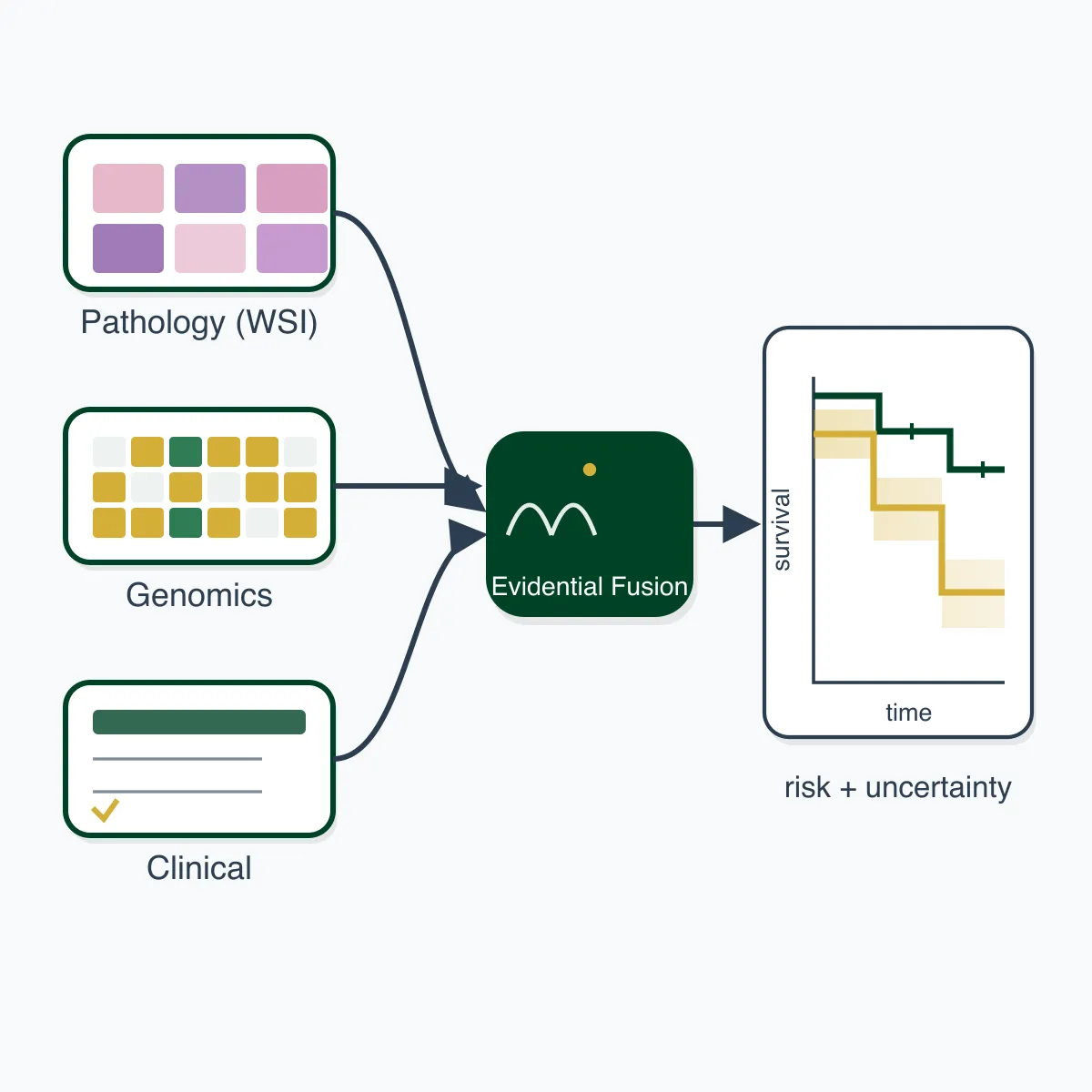
Description: Uncertainty-aware fusion architectures that integrate heterogeneous medical data for reliable, interpretable patient survival prediction.
Challenge: Survival analysis relies on diverse, multimodal data (whole-slide images, clinical records, genomics) that is often noisy, conflicting, and right-censored. Standard deep models struggle to fuse these sources while providing the transparency and uncertainty quantification clinicians need to trust a prediction.
Approach: Evidential multimodal fusion frameworks, such as EsurvFusion and DPsurv, grounded in belief-function theory and epistemic random fuzzy sets. The models quantify both data and model uncertainty, and use reliability discounting and dual-prototype fusion to integrate complex data streams safely.
Key Findings: The models reach state-of-the-art accuracy and interpretability for time-to-event prediction. By learning the reliability of each modality and quantifying uncertainty, they avoid overconfidence on noisy data and give clearer, clinically usable predictions.
Related Publication: EsurvFusion: An evidential multimodal survival fusion model based on Epistemic random fuzzy sets (IEEE Transactions on Fuzzy Systems, 2025) | DPsurv: Dual-Prototype Evidential Fusion for Uncertainty-Aware and Interpretable Whole-Slide Image Survival Prediction (ICML 2026)
Uncertainty Quantification in Medical Image Analysis
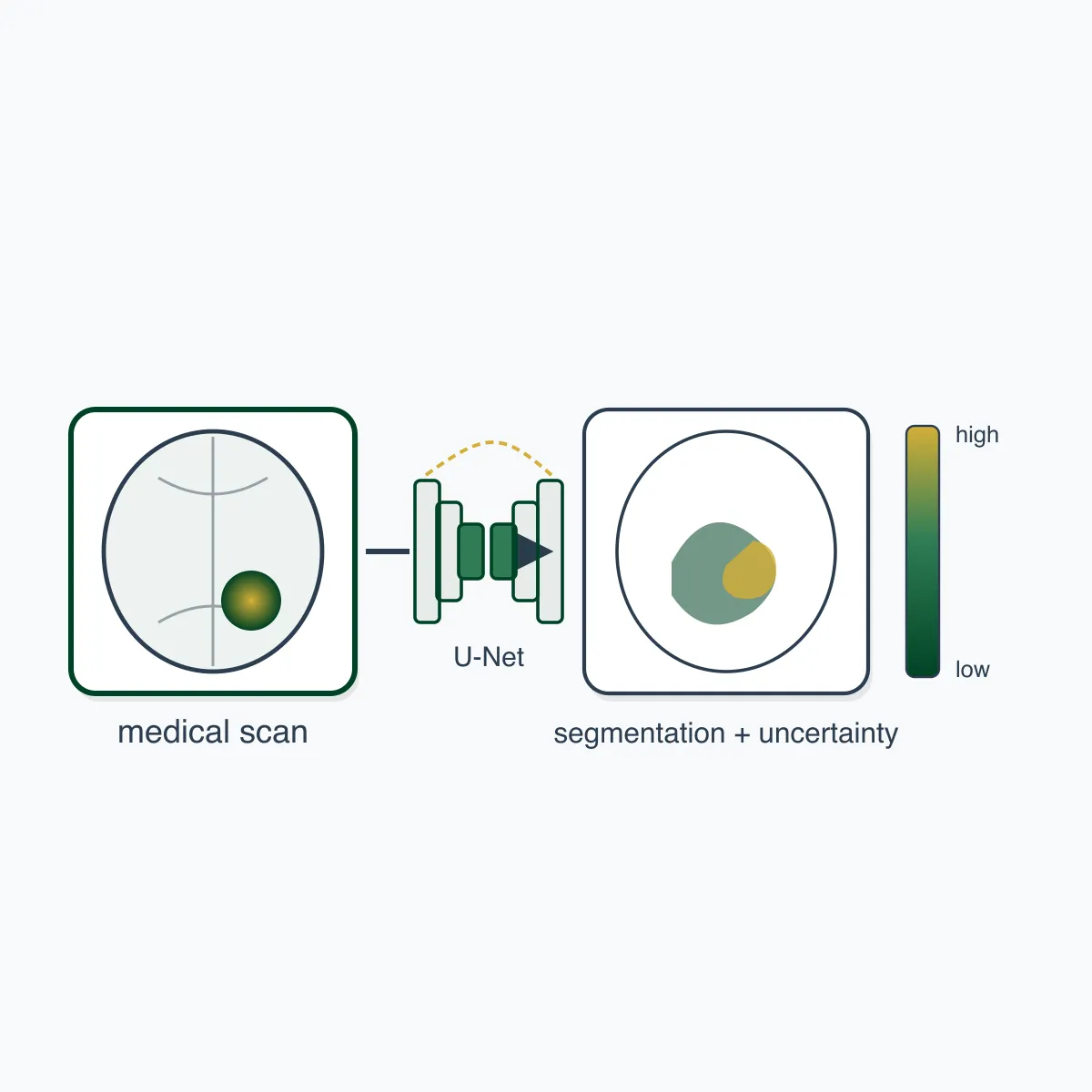
Description: Deep evidential learning frameworks and belief-function theory to quantify uncertainty and improve reliability in medical image segmentation.
Challenge: Medical images such as MRI and PET scans are often degraded by noise, artefacts, or ambiguous tissue boundaries. Standard deep learning models output deterministic segmentation masks without indicating their confidence, and can produce highly confident but incorrect predictions in exactly the cases that matter for patient safety.
Approach: Integrating belief-function theory with deep neural networks to build deep evidential networks. The approach uses mechanisms such as contextual discounting to manage conflicting multi-modality data, alongside semi-supervised learning to make the most of limited expert-annotated data.
Key Findings: By modelling masses of belief, these frameworks achieve accurate segmentation while also producing spatial uncertainty maps. The models down-weight unreliable imaging contexts and can explicitly signal "ignorance" when data is insufficient, flagging high-risk regions for clinical review.
Related Publication: A review of uncertainty quantification in medical image analysis: probabilistic and non-probabilistic methods (Medical Image Analysis, 2024) | Deep evidential fusion with uncertainty quantification and reliability learning for multimodal medical image segmentation (Information Fusion, 2024)
Multimodal Learning for Clinical Decision Support Systems
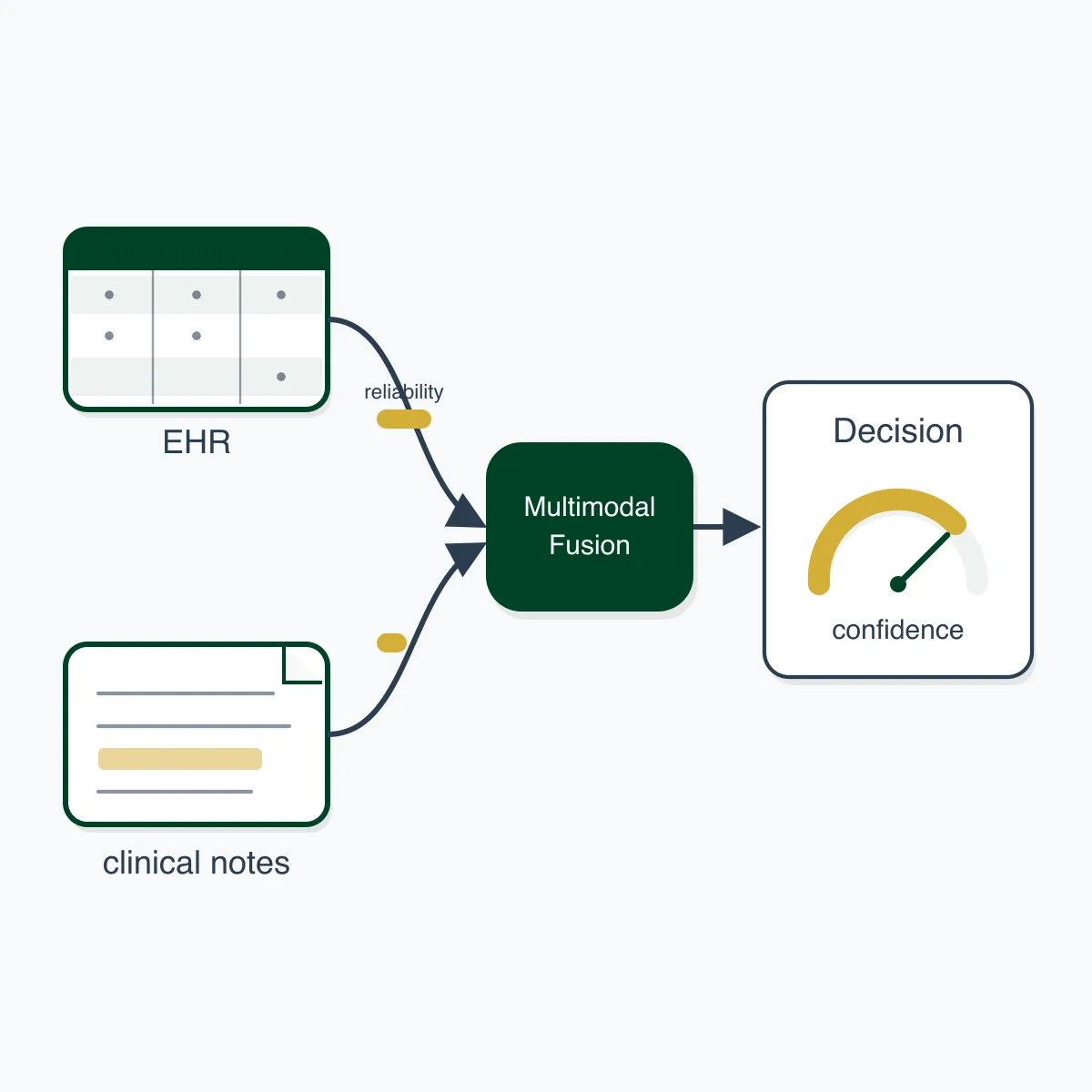
Description: Integrating structured electronic health records (EHRs) and free-text clinical notes with multimodal and foundation models to build reliable predictive systems for patient care.
Challenge: Hospital data is diverse, spanning structured clinical measurements (heart rate, lab results) and unstructured free text (clinical notes, discharge summaries). Most models handle these modalities separately and miss information held in the natural-language notes that matters for tasks such as ICU-outcome or chronic-disease prediction.
Approach: Using multimodal foundation models and belief-function theory to fuse structured EHRs with clinical text. Domain adaptation and evidential reasoning align the data streams while keeping an explicit measure of diagnostic reliability.
Key Findings: The multimodal frameworks improve accuracy on tasks such as ICU-outcome and chronic-disease prediction. A systematic evaluation of clinical foundation models also maps what is needed for broadly capable healthcare AI without compromising clinical safety.
Related Publication: Towards accurate and reliable ICU outcome prediction: a multimodal learning framework based on belief function theory using structured EHRs and free-text notes (Journal of Healthcare Informatics Research, 2025) | Has multimodal learning delivered universal intelligence in healthcare? A comprehensive survey (Information Fusion, 2024)