
Ling Huang
Imperial College London, National University of Singapore, University of Technology of Compiègne, French National Centre for Scientific Research, Sorbonne University
Dr. Ling HUANG is postdoc research associate at the Imperial College London. Before this, she was a Research Fellow at the National University of Singapore. She did her doctoral study at the Université de Technologie de Compiègne, under the supervision of Prof.Thierry Denoeux and Prof.Su Ruan. Her research focuses on developing trustworthy AI solutions to ensure decision accuracy, epecially focus on uncertainty quantification, multi-modality information fusion, and reliable and explainable decision-making with state-of-the-art deep models such as foundation models, LLM, etc. Her work was recognized by well-established journals, such as Information Fusion, IEEE trans. on Fuzzy systems, Medical Image Analysis,Ieee trans on cybernetics, and Int. Journal of Approximate Reasoning, Knowledge-Based Systems, and top international conferences, such as MICCAI, ACL and ISBI, BELIEF.
Research Interests
- Uncertainty Quantification
- Multimodal Information Fusion
- Dempster-Shafer theory
- Trustworthy AI
- Causian Inference
- Natural Language Processing
- Cancer survival analysis
- Cardivascual computing
- Gene-environment analysis
Scientific Activites
Previous & Existing fundings
- Dame Julia Higgins Postdoc Collaborative Research Fund, ‘Revolutionizing Cancer Survival Analysis Through Trustworthy AI and Multimodal Integration,’ 2025-2026, PI
- Dame Julia Higgins Postdoc Collaborative Research Fund, ‘Automating Environmental Health Literature Screening Using Large Language models,’ 2025-2026, Co-PI
Professional Services
- Editorial Board: Information Fusion
- BELIEF 2026 Committees members
- Peer reviwer: Information Fusion, Medical Image Analysis, Knowlwdge-based systems, IJAR
Awards
- IJAR Best paper rewards (2024 BELEIF conference)
- French Society of Biological and Medical Engineering (SFGBM) 2024 Thesis Prize
- Frontrunner 5000 -Top Articles from Outstanding S&T Journals of China (2021)
- Journal of Software High Impact Papers (2019 and 2020)
- Excellent graduation thesis of Zhejiang University of Technology (2019)
- Outstanding Graduates of Zhejiang Province (2019)
- Chinese National Scholarship (The highest honor for graduate students) (2017)
- Outstanding Graduates of Anhui University of Technology (2016)
- Turkey Mevlana Exchange student scholarship (2015)
Publications
-
Optimization of deep convolutional neural network for large scale image retrieval
-
A review of uncertainty quantification in medical image analysis: Probabilistic and non-probabilistic methods
-
Has multimodal learning delivered universal intelligence in healthcare? A comprehensive survey
Information Fusion 116, 102795, 2025Q Lin, Y Zhu, X Mei, L Huang, J Ma, K He, Z Peng, E Cambria, M Feng -
Lymphoma segmentation from 3D PET-CT images using a deep evidential network
International Journal of Approximate Reasoning 149, 39-60, 2022L Huang, S Ruan, P Decazes, T Denoeux -
Saliency-based multi-feature modeling for semantic image retrieval
Journal of Visual Communication and Image Representation 50, 199-204, 2018C Bai, J Chen, L Huang, K Kpalma, S Chen -
Deep evidential fusion with uncertainty quantification and reliability learning for multimodal medical image segmentation
-
Unsupervised adversarial instance-level image retrieval
-
Application of belief functions to medical image segmentation: A review
-
Evidence fusion with contextual discounting for multi-modality medical image segmentation
-
Belief function-based semi-supervised learning for brain tumor segmentation
-
Optimization of deep convolutional neural network for large scale image classification
-
Covid-19 classification with deep neural network and belief functions
-
Semi-supervised multiple evidence fusion for brain tumor segmentation
-
Deep PET/CT fusion with Dempster-Shafer theory for lymphoma segmentation
-
Evidential segmentation of 3D PET/CT images
-
Self-supervised quantized representation for seamlessly integrating knowledge graphs with large language models
-
Adversarial learning for content-based image retrieval
2019 IEEE Conference on Multimedia Information Processing and Retrieval …, 2019L Huang, C Bai, Y Lu, S Chen, Q Tian -
An evidential time-to-event prediction model based on Gaussian random fuzzy numbers
-
Unsupervised adversarial image retrieval
-
Instance image retrieval with generative adversarial training
International Conference on Multimedia Modeling, 381-392, 2019H Li, C Bai, L Huang, Y Jiang, S Chen -
Evidential time-to-event prediction with calibrated uncertainty quantification
International Journal of Approximate Reasoning 181, 109403, 2025L Huang, Y Xing, S Mishra, T Denœux, M Feng -
EsurvFusion: An evidential multimodal survival fusion model based on Gaussian random fuzzy numbers
-
Towards reliable medical image segmentation by utilizing evidential calibrated uncertainty
arXiv preprint arXiv:2301.00349, 2023K Zou, Y Chen, L Huang, X Yuan, X Shen, M Wang, RSM Goh, Y Liu, H Fu -
Improving clinical foundation models with multi-modal learning and domain adaptation for chronic disease prediction
-
A foundation model for chest x-ray interpretation with grounded reasoning via online reinforcement learning
arXiv preprint arXiv:2509.03906, 2025Q Lin, Y Zhu, B Pu, L Huang, H Luo, J Ma, Z Peng, T Zhao, F Xu, J Zhang, ... -
An evidence-based framework for heterogeneous electronic health records: A case study in mortality prediction
-
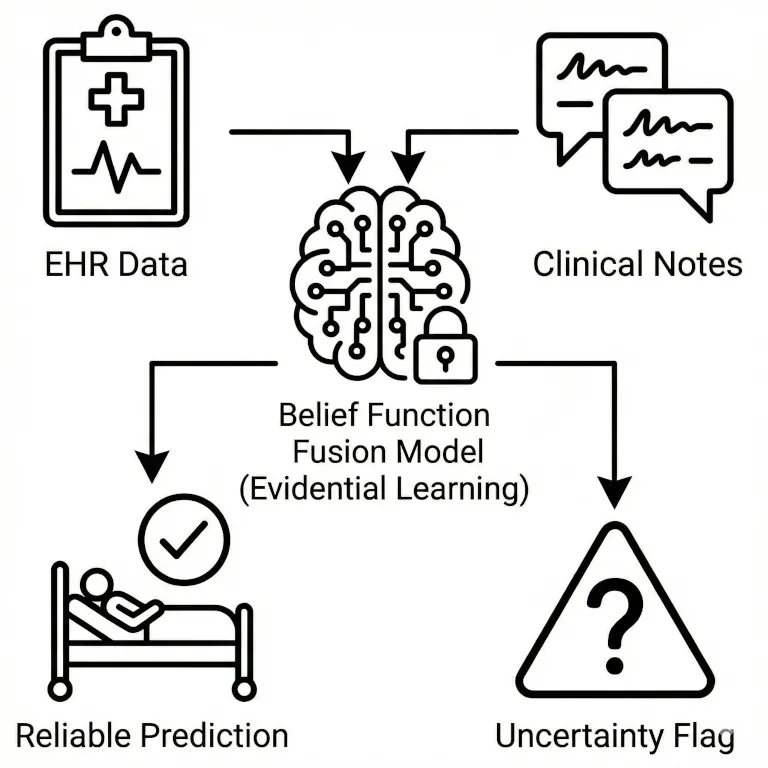
Towards accurate and reliable ICU outcome prediction: a multimodal learning framework based on belief function theory using structured EHRs and free-text notes
-
Domain-continual learning for multi-center anatomical detection via prompt-enhanced and densely-fused MedSAM
-
Evidence-based multimodal fusion on structured EHRs and free-text notes for ICU outcome prediction
-
Adversarial example detection and defense based on the evidence consistency from Dempster-Shafer layers
-
EsurvFusion: An evidential multimodal survival fusion model based on Epistemic random fuzzy sets
-
DPsurv: Dual-Prototype Evidential Fusion for Uncertainty-Aware and Interpretable Whole-Slide Image Survival Prediction
arXiv preprint arXiv:2510.00053, 2025Y Xing, L Huang, J Ma, R Hong, J Qiu, P Liu, K He, H Fu, M Feng -
Toward Reliable Medical Image Segmentation by Modeling Evidential Calibrated Uncertainty
IEEE Transactions on Cybernetics, 2025K Zou, Y Chen, L Huang, N Zhou, X Yuan, X Shen, M Wang, RSM Goh, ... -
Medical image segmentation with belief function theory and deep learning