IEEE Transactions on Fuzzy Systems - EsurvFusion: An evidential multimodal survival fusion model based on Epistemic random fuzzy sets
Fusing messy multimodal medical data — while learning which sources to trust.
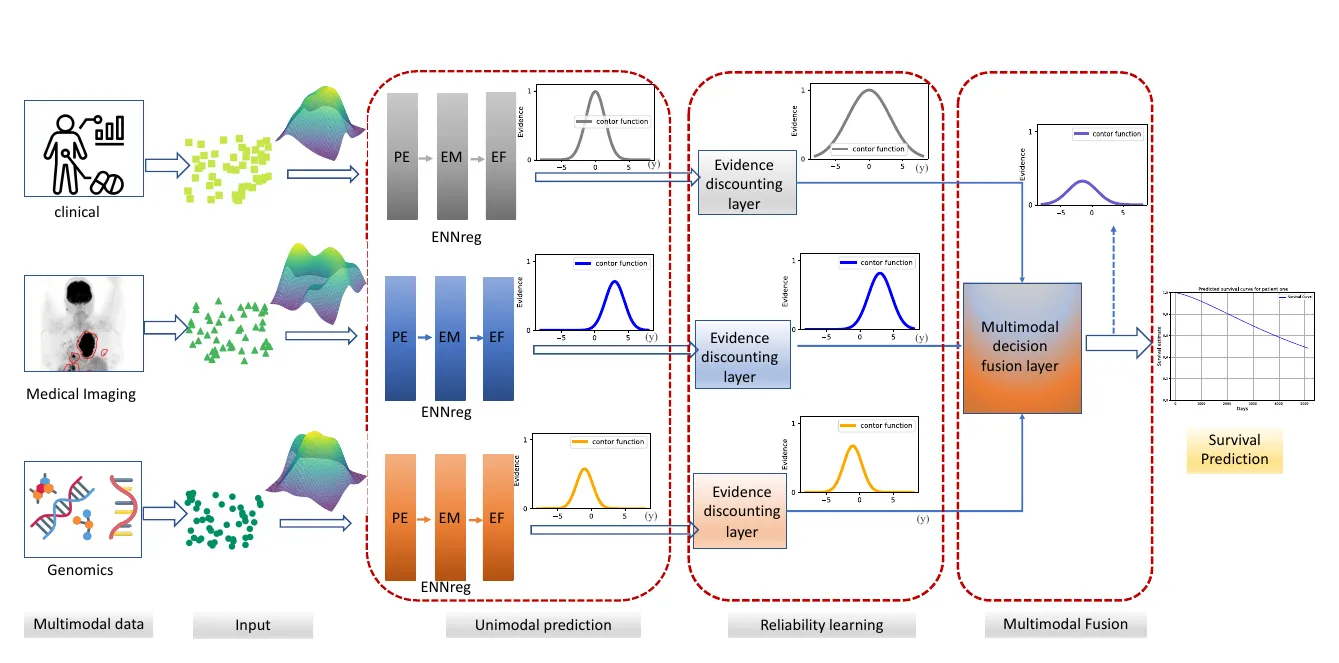
The problem. Predicting patient survival means combining very different data — clinical records, imaging, genomics — that vary in quality and noise, with outcomes that are often censored (only partially observed). Most fusion methods treat every modality as equally reliable and emit a single number, ignoring both how uncertain a prediction is and how trustworthy each source is.
Our idea. EsurvFusion fuses modalities at the decision level. Each modality is first modelled with Gaussian Random Fuzzy Numbers, producing a survival prediction together with its aleatoric (data) and epistemic (model) uncertainty. A reliability discounting layer then learns how much to trust each modality and down-weights noisy ones, before an evidence-based fusion layer combines them. It is the first multimodal survival model to handle both uncertainty and reliability — and because the reliability coefficients are learnt explicitly, you can read off how much each modality contributed.
The result. Tested on four cancer cohorts — HECKTOR 2022 (head-and-neck, PET/CT + clinical) plus BRCA, BLCA, and COADREAD (clinical + genomic) — EsurvFusion sets a new state of the art over both single-modality and multimodal fusion baselines (e.g. C-index 0.703 on the head-and-neck cohort), while remaining interpretable and robust to noisy modalities.
IEEE Transactions on Fuzzy Systems · Ling Huang (first author) · Read on arXiv