MICCAI 2026 - Evidential Fusion Network for Multimodal Survival Prediction under Missing Modalities
Survival prediction that degrades gracefully when data is missing — instead of guessing.
The problem. The best multimodal survival models combine pathology whole-slide images with transcriptomic (gene-expression) data — but in real clinics one modality is often missing (tissue exhausted, sequencing too costly). Common fixes either impute the missing data, which risks hallucinating biological signals that aren’t there and adds computation, or simply mask it, without ever quantifying how much information was lost.
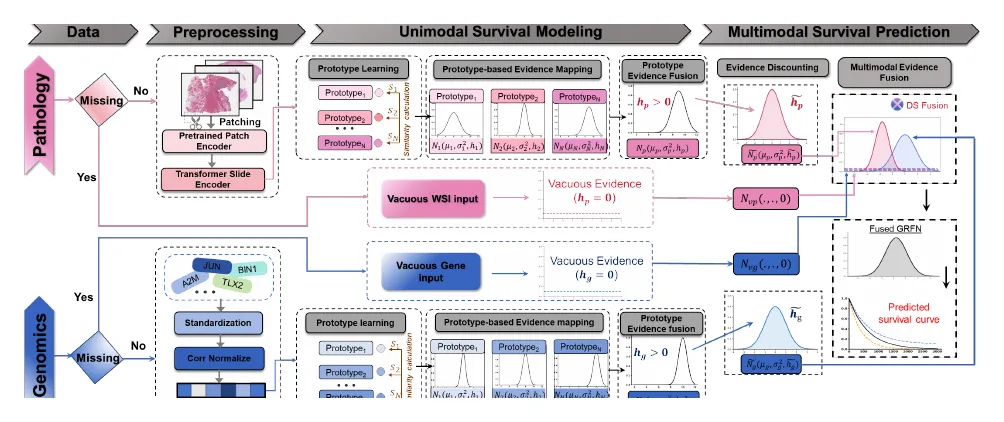
Our idea. EMMS (Evidential Missing-Modality Survival fusion) sidesteps reconstruction entirely. Built on Dempster–Shafer evidence theory and Gaussian Random Fuzzy Numbers, each modality’s prediction is expressed as survival evidence carrying aleatoric and epistemic uncertainty. A missing modality is treated as vacuous evidence — its epistemic strength is set to zero, so it contributes nothing rather than being fabricated. The modalities are then fused with Dempster’s rule, and the total evidential strength becomes a built-in, interpretable measure of the uncertainty that the missingness introduced.
The result. Across four TCGA cohorts (BRCA, STAD, KIRC, LUAD), EMMS achieves state-of-the-art discrimination and calibration under both fully-observed and heavily incomplete settings — holding up even when 60% of modalities are missing (e.g. C-index ~0.80 on KIRC) — and does so with no extra computational overhead versus an imputation-free baseline.
MICCAI 2026 · Ling Huang (corresponding author)