ICML 2026 - DPsurv: Dual-Prototype Evidential Fusion for Uncertainty-Aware and Interpretable Whole-Slide Image Survival Prediction
Survival predictions that show their reasoning — and know when they’re unsure.
The problem. Pathology whole-slide images (WSIs) are rich sources for cancer prognosis, but most survival models are black boxes that emit a single point estimate. They neither explain which tissue drives the prediction nor convey how confident they are — risky in a clinical setting, especially given heterogeneous tissue and censored (incomplete) follow-up data.
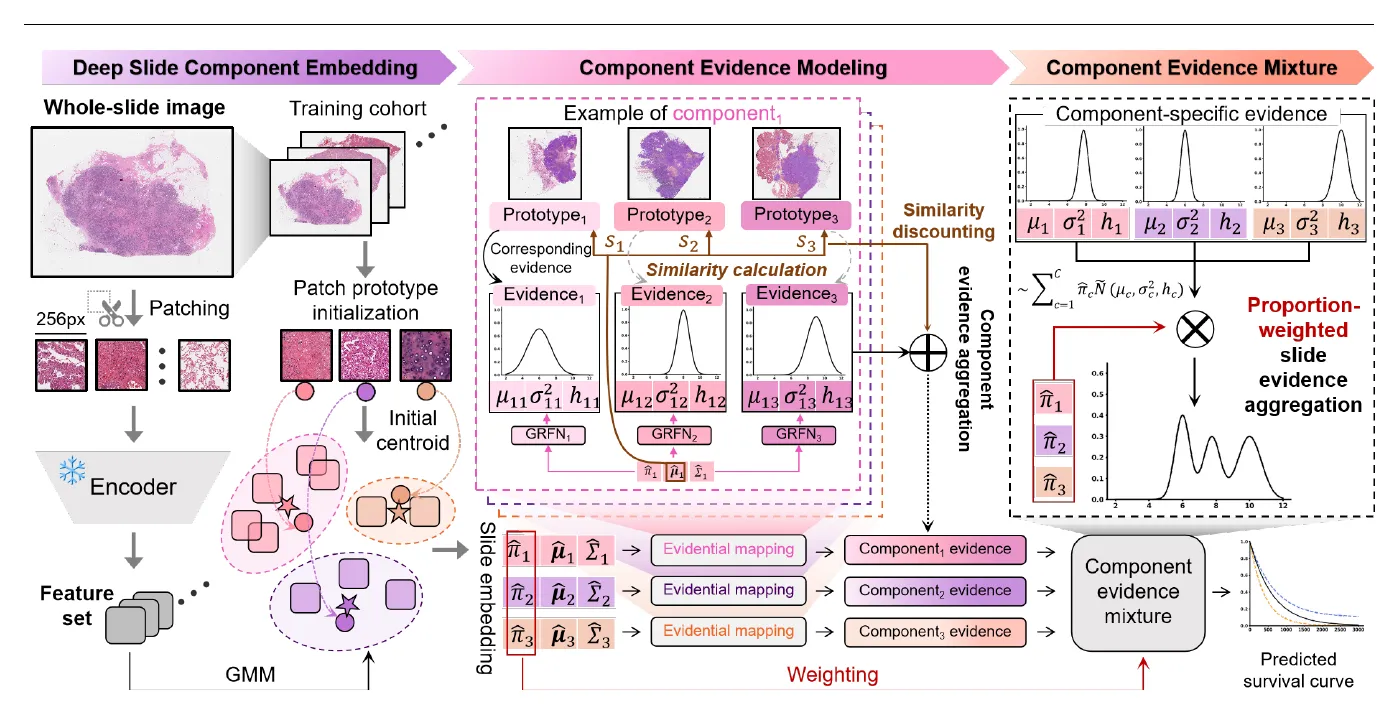
Our idea. DPsurv treats each slide as a mixture of distinct tissue components (learned via patch prototypes and a Gaussian mixture model). Each component is mapped to survival evidence using Gaussian Random Fuzzy Numbers, which carry both data (aleatoric) and model (epistemic) uncertainty, and these are fused into a slide-level prediction with explicit belief/plausibility intervals rather than a bare number. The same structure makes it interpretable end-to-end: you can trace a prediction from tissue regions → component evidence → relative risk — and two board-certified pathologists confirmed the learnt prototypes map to genuine morphological subtypes.
The result. Across five TCGA cancer types (BRCA, BLCA, LUAD, UCEC, KIRC), DPsurv achieves the highest mean C-index (0.704) and the best-calibrated uncertainty (lowest mean IBS 0.310 and IBLL 0.824) — i.e. it discriminates risk well while its confidence intervals are trustworthy.
ICML 2026 · Ling Huang (corresponding author) · Read on arXiv · Code