ECCV 2026 - Semantic-Anchored Evidential Fusion for Domain-Robust Whole-Slide Survival Analysis
Survival prediction that holds up when you move it to a new hospital.
The problem. AI models that predict cancer survival from pathology whole-slide images (WSIs) tend to break down when deployed at a different clinic. They quietly latch onto centre-specific artefacts — staining protocols and scanner hardware — rather than the underlying biology, so accuracy can collapse on slides from an unseen hospital.
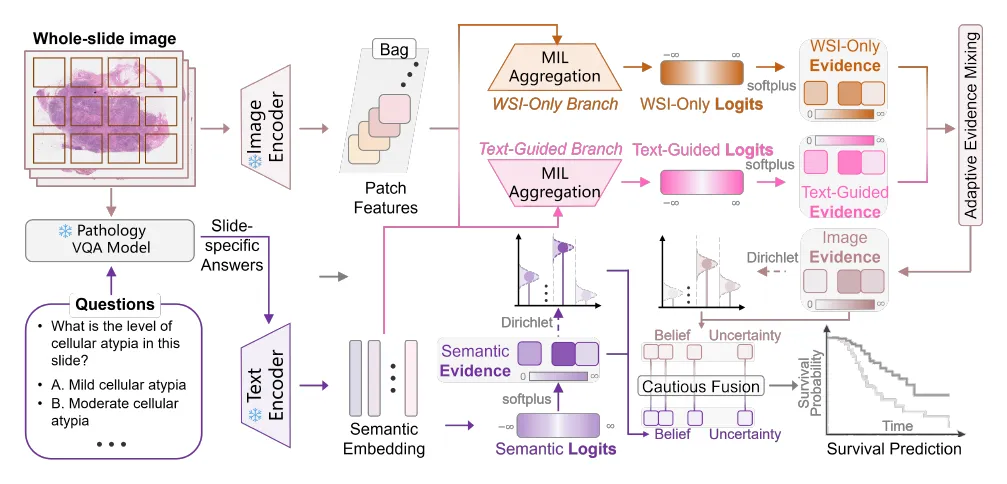
Our idea. We anchor the model in pathology semantics — high-level concepts such as tumour grade, necrosis, and vascular invasion — which stay stable across centres the way a pathologist’s judgement does. SAEFS extracts these semantic anchors automatically from each slide using a pathology vision–language model (via template-based visual question answering), then fuses them with the raw image evidence through cautious belief fusion: an uncertainty-aware rule that avoids overconfidence when the two correlated sources reinforce each other.
The result. Trained on a single source cohort (TCGA) and evaluated zero-shot on unseen hospitals (CPTAC, NLST), SAEFS improves the average concordance index by +10.2% over the strongest baseline — with the largest gains exactly where the cross-centre shift is most severe. The semantic anchors show roughly 73% lower cross-centre divergence than raw image features, confirming why they generalise.
ECCV 2026 · Ling Huang (corresponding author) · Read on arXiv